


4
Polyurethane Concrete Sealer vs Epoxy Coatings: Why CoverShield U100 Is a Smarter Alternative
When people think about protecting concrete floors, they often look first at epoxy coatings. Epoxy is known for toughness, but it can also come with more complicated installation, shorter working time, and more demanding surface preparation.
That is why many contractors and facility owners look for an epoxy alternative that still delivers strong stain resistance, durability, and long-term value. CoverShield U100 is a polyurethane concrete sealer designed to protect concrete and terrazzo floors while being easier to apply and more cost-effective on many projects.
What Is CoverShield U100?
CoverShield U100 is a water-based urethane concrete sealer with a clear matte finish. It is designed for interior and exterior concrete and terrazzo floors. It can be applied with a pump sprayer, microfiber mop, T-bar, or roller, which gives installers flexible application options depending on the job site.
According to the product page, CoverShield U100 offers up to 800 square feet of coverage per gallon, making it a very efficient coating for large floor areas. It is also promoted as stain and chemical resistant, abrasion resistant, scratch resistant, waterproof, odorless, and non-yellowing UV stable. The product page also notes that it is safe for food contact and durable enough to hold up to forklift traffic.
Why Use a Polyurethane Concrete Sealer Instead of Epoxy?
Epoxy coatings are often selected because they can build a hard, protective film. However, that extra build often comes with tradeoffs. In many cases, a polyurethane concrete sealer like CoverShield U100 offers a more practical balance of protection, appearance, and ease of installation.
1. Easier Surface Preparation
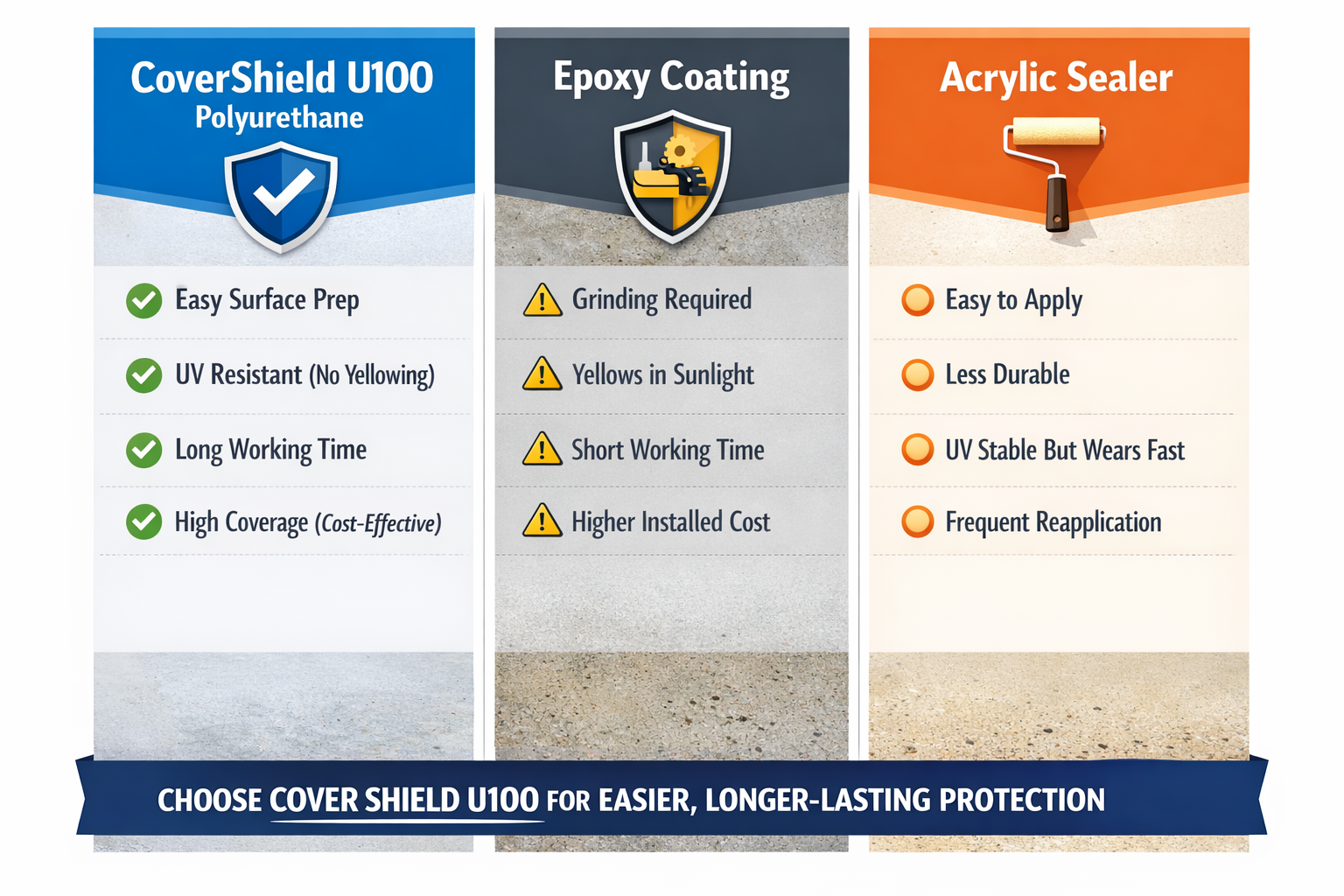
One of the biggest advantages of U100 over many epoxy systems is easier prep. Epoxy coatings commonly require aggressive mechanical profiling such as grinding or shot blasting to achieve proper adhesion. That adds labor, equipment costs, dust, noise, and downtime.
With CoverShield U100, the installation process is generally more straightforward. For many concrete floors, a strong cleaning and preparation process is enough, without the need for heavy grinding equipment. That makes U100 a very appealing epoxy alternative for concrete floors when you want to reduce labor and simplify the job.
2. Non-Yellowing and UV Resistant
Many epoxy coatings can amber or yellow over time, especially in areas that get sunlight. This is a major drawback for decorative concrete, retail floors, showrooms, and other spaces where appearance matters.
CoverShield U100 is promoted as non-yellowing and UV stable. That means the finish is better suited for spaces where you want the concrete to keep a clean, natural look over time.
3. Longer Working Time
Epoxy coatings often have a short pot life once mixed. That can make the application process stressful, especially on larger jobs. Installers may have to move very quickly, increasing the risk of lap marks, wasted material, and uneven results.
U100 offers a longer working window, which gives applicators more time to spread the product evenly and maintain a more consistent finish. This can make it easier to use, especially for crews looking for a reliable high-performance sealer without the pressure of a fast-setting coating.
4. Easy Application
Another reason U100 works well as an epoxy alternative is ease of application. The product page lists multiple application methods, including a pump sprayer, microfiber mop, T-bar, and roller. That flexibility can help installers choose the method that best matches the floor and the size of the area.
This is especially helpful for maintenance teams, contractors, and facility managers who want a professional-grade result without the complexity often associated with thicker resinous coatings.
5. High Coverage Rate and Strong Value
Coverage matters because it has a direct effect on project cost. CoverShield U100 is listed at 800 square feet per gallon, which is a strong coverage rate for a protective concrete coating.
That means one gallon can go a long way, helping reduce material cost per square foot. When you combine that with easier prep and easier application, U100 becomes a very cost-effective concrete sealer for many commercial and residential projects.
6. Durable Protection for Real-World Floors
U100 is designed to resist staining, chemicals, abrasion, and scratches. It is also described as easy to clean and maintain. These are important benefits for spaces that see regular traffic, spills, or demanding service conditions.
The product page specifically highlights uses including concrete susceptible to staining and discoloration, stained and decorative concrete inside or outside, cement terrazzo, and polished concrete. That makes it a strong choice for restaurants, retail stores, schools, commercial interiors, and other active spaces.
Best Applications for CoverShield U100
- Decorative concrete floors
- Polished concrete
- Cement terrazzo
- Interior commercial floors
- Exterior covered concrete areas
- Floors that need stain resistance and easy maintenance
CoverShield U100 vs Epoxy: Quick Summary
- U100 is easier to prepare for: no grinding is typically needed on many jobs
- U100 is UV stable: better for areas with sunlight exposure
- U100 has longer working time: easier application and more control
- U100 has high coverage: up to 800 sq. ft. per gallon
- U100 is cost-effective: lower labor burden and efficient material usage
Final Thoughts
If you are comparing a polyurethane concrete sealer vs epoxy, the right choice often comes down to balancing performance with practicality. Epoxy coatings can be strong, but they often require more preparation and more demanding application conditions.
CoverShield U100 gives you a different path. It offers strong stain resistance, chemical resistance, abrasion resistance, UV stability, and excellent coverage, all in a water-based urethane system that is easier to apply. For many projects, that makes it one of the smartest and most practical epoxy alternative options available.
Frequently Asked Questions
Is polyurethane concrete sealer better than epoxy?
For many floors, a polyurethane concrete sealer is the better choice because it is easier to apply, more UV stable, and often more cost-effective. Epoxy can be harder to install and may yellow in sunlight.
Does CoverShield U100 require grinding before application?
One of the main advantages of U100 is easier surface preparation. Many projects can be completed with proper cleaning and prep without the grinding often associated with epoxy coatings.
Is CoverShield U100 UV resistant?
Yes. The product page lists CoverShield U100 as non-yellowing and UV stable, which helps it keep its appearance over time.
What is the coverage rate of CoverShield U100?
The listed coverage is up to 800 square feet per gallon, depending on the surface and conditions.
Where can CoverShield U100 be used?
It is designed for interior and exterior concrete and terrazzo floors, including decorative concrete, polished concrete, and areas prone to staining and discoloration.