CoverTec - MADE In USA

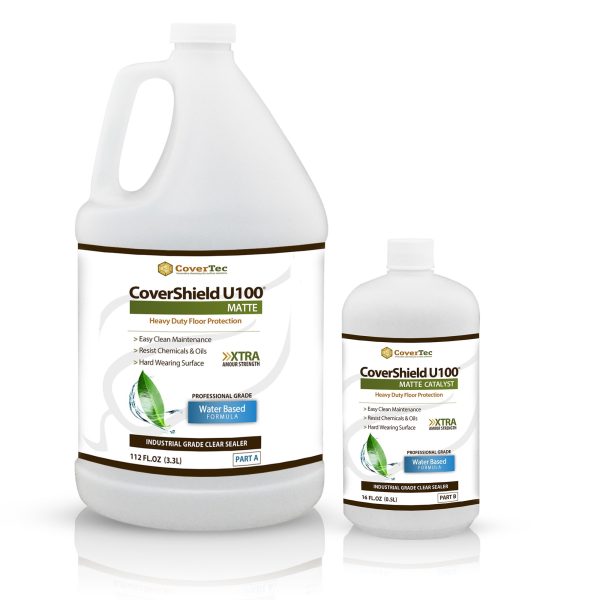
Stain Resistant Concrete Sealer – CoverShield U100 Matte Finish

Delivery Time: Typically 3 to 5 business days 

Frequently Bought Together

Stain Resistant Concrete Sealer - CoverShield U100 Matte Finish - 4 Gal Kit + SurfaceClean Hard Surface Cleaner and Degreaser - 1 Qrt + 18" Microfiber Flat Mop Frame + 18" Microfiber Flat Mop Pad
Price for all: $517.75

Stain Resistant Concrete Sealer – CoverShield U100 Matte Finish

Price range: $15.00 through $471.50

In stock

Description

CoverShield U100 Acid & Stain-Resistant, Odorless, Clear Matte Finish Concrete Sealer

High Performance Stain Resistant Sealer for Concrete and Terrazzo Floors

CoverShield U100 Matte Product video

CoverShield U100 Matte Un-boxing video

Features

Typical Uses

Shelf Life

12 months when stored at 77°F (25°C) or less in a dry and shaded area. Protect from freezing.

Theoretical Coverage

Approximately 800ft2 /gallon (19.6 m2 /liter) per coat depending on the density and porosity of the surface.

Protect Your Porous Surfaces with a Stain Resistant Concrete Sealer

Protect Your Porous Surfaces with a Stain Resistant Concrete Sealer

Concrete is a fascinating, but intricate material that helps to form the most fundamental parts of our homes, driveways and sidewalks. As one of the most common elements of urban construction, concrete is often overlooked as a material that requires ongoing maintenance if you want it to look its best. Enter the stain-resistant sealer: your concrete’s best friend and a valuable ally in the fight against the dreaded signs of wear and tear.
In this blog post, we will discuss the importance of using a stain-resistant sealer on your concrete surfaces and break down the various types of sealers and their respective benefits. We will also address specific situations in which the use of a stain-resistant sealer is especially helpful and share some tips to help ensure your sealers hold up over time. So if you want to get the most out of your concrete surfaces and keep them looking good for years to come, read on!

Quick Response to a Key Question

There are many types of stain resistant concrete sealers on the market that can provide excellent protection for your concrete surfaces. The type of sealer that works best for you will depend on the type of substrate, climate, and exposure to wear and tear.

What are Stain Resistant Concrete Sealers?

Stain resistant concrete sealers are coatings that are applied to a concrete surface to prevent staining and make it easier to clean. To many, applying a sealer that resists staining might seem like a no-brainer. However, there are always things to consider before taking the plunge. With that said, stain resistant sealers provide several benefits like:
  • Improved aesthetics,
  • Protection from discoloration,
  • Increased resistance to abrasion,
  • Improved durability in harsh weather conditions.
On the other hand, there is some debate about whether or not these products are necessary for decorative concrete surfaces. Some argue that these products are unnecessary because sealers can be expensive and difficult to apply correctly.
Yet, when appropriately applied, stain resistant sealers can help protect a concrete surface from stains and discoloration caused by dirt, oil, and grease build-up over time. With regular maintenance and proper application of a quality product, the result is a longer-lasting, better looking surface that will remain protected for many years to come.
When considering whether or not to apply a stain resistant concrete sealer, it is important to weigh the pros and cons carefully and decide what works best for your particular application. The next section will outline some of the key benefits of using a stain resistant concrete sealer in order to protect your surface from stains and discoloration over time.

Main Points to Remember About Floor Sealer Products

A stain resistant concrete sealer can be beneficial to protect a surface from stains, increase durability and improve aesthetics. However, it is important to weigh the pros and cons carefully before deciding if a sealer is necessary as they can be expensive and difficult to apply correctly.
With appropriate application and regular maintenance, the result can be a long-lasting, better looking surface that will remain protected for many years to come.

Benefits of Using a Stain Resistant Concrete Sealer

Using a stain resistant concrete sealer on your concrete surfaces provides many benefits, including long-term protection and increased lifespan of the concrete. A quality sealer will help keep out damaging elements such as rain, snow and ice salt, as well as preventing staining from food, beverage and other spills. With a good sealer, you can rest assured that your concrete will remain clean and looking great for years to come.
Another benefit of using a stain resistant sealer is that it prevents the growth of mold, mildew, and fungus on the surfaces of your concrete. These organisms can cause damage and discoloration to unprotected concrete and be hazardous to one’s health. When a concrete surface is sealed with a quality stain-resistant product, it keeps these organisms away while keeping the area safe.
On the flip side, there are some drawbacks to applying a stain resistant sealer to your concrete. One of the most common is that it can make subsequent cleaning more difficult because the seal prevents penetration by cleaning agents. Additionally, stain resistant sealers can be more expensive than regular concrete coatings due to higher polymer content and more specialty additives.
In conclusion, using a stain resistant concrete sealer offers many advantages in terms of protecting your surfaces from staining and weather damage as well as preventing mold and fungus from growing on the concrete. Despite a few minor drawbacks such as additional costs for upkeep and possible difficulties with cleaning, overall a stain-resistant sealer is definitely worth looking into for the protection of your valuable surfaces. Now that we have discussed the benefits of using a stain resistant sealer let’s move onto how it can protect your concrete surfaces from weather elements in our next section.
  • According to an independent study conducted in 2020, film forming concrete sealers like water based urethanes have proven to provide the highest level of protection against water and oil-based stains on existing and new concrete.
  • The study further examined penetrating sealers and found that silane/siloxane solutions provide excellent protection against water ingress but flouropolymer based penetrating sealer provided the best protection against staining.
  • A further study concluded that the application of a quality topical applied stain resistant concrete sealer can reduce staining from acid, alkaline and salt sources by up to 85%.

Protection from Weather Elements

Protecting your concrete from weather elements is essential to prolong its life and ensure it remains beautiful over time. A sealer acts as a protective layer, defending the concrete surfaces against environmental damage. Rain, snow and sunlight can all cause long-term deterioration of your concrete surfaces if they are not properly sealed.
Investing in a sealer that offers protection from weather elements is a wise choice for homeowners and business owners alike. Sealers help to lock out moisture and protect against freeze-thaw cycles which can occur during winter months. When exposed to water and moisture, unsealed concrete is vulnerable to pitting, spalling, flaking, cracking and disintegration. The sealer helps reduce damage caused by exposure to the sun’s UV rays by creating a barrier which blocks out up to 98 percent — sometimes more — of unwanted radiation coming through onto the surface.
On one hand, the benefits of a sealer seen with protection from weathering elements cannot be argued; however, some argue that sealer may trap moisture in the slab leading to further damage. To combat this argument, many experts recommend being aware of how much sealer should be applied and how frequently it should be reapplied to avoid over application. Furthermore, selecting a breathable sealer that still offers water resistance may be an option as well.
To ensure the maximum life span of your concrete surface and keep its look intact, applying a stain resistant sealer that also offers protection from weather elements is highly recommended. By doing this you will extend the life expectancy of your investment while living worry free knowing that your exterior or interior concrete surface is safeguarded against future decay and discoloration.
Fortunately for homeowners and businesses alike, sealing concrete surfaces with a good quality product does not have to be expensive or difficult thanks to advancements in technology related to sealers. With these new developments comes greater assurance of protection against weather elements but also spills and stains which we will discuss next in our article.

Protection from Spills and Stains

Protecting your concrete from spills and stains is a critical component of preserving its beauty, longevity, and integrity. Without protection, liquids that penetrate the surface can cause deterioration, discoloration, and staining. Fortunately, there are various products on the market that can provide this necessary protection for your concrete surfaces.
Sealants provide a barrier between the concrete surface and any spilled substances. This prevents damage from happening to the surface by stopping liquids from seeping into the material. Many types of sealers are stain resistant, meaning they are specially formulated to resist oil, water, and other liquids capable of leaving stains behind. Some varnishes and coatings may also be used to provide temporary protection.
On the other hand, some argue that sealers will not last forever and will require periodic reapplication in order to maintain their effectiveness in repelling spills and stains. This could add up over time as it may involve additional labor costs or hassle when dealing with the process of stripping existing coats or layers before adding new ones.
As such, it is important to carefully weigh your options if you plan to use a sealant or coating to protect your concrete surfaces against spills and stains. Ultimately though, for those who want maximum protection for their outdoor spaces or outdoor furniture that makes use of concrete surfaces, investing in a quality stain-resistant sealer is likely worth considering.
With that said, now that we’ve gone through considerations for protecting against spills and stains it’s time to look at the different types of stain-resistant concrete sealers available on the market today.

Key point: Using Oil Repellent Sealer Products

Protecting your concrete from spills and stains is a critical component of preserving its beauty, longevity, and integrity. Without protection, liquids that penetrate the surface can cause deterioration, discoloration, and staining. Fortunately, there are various products on the market that can provide this necessary protection for your concrete surfacesProtecting your concrete from spills and stains is a critical component of preserving its beauty, longevity, and integrity. Without protection, liquids that penetrate the surface can cause deterioration, discoloration, and staining. Fortunately, there are various products on the market that can provide this necessary protection for your concrete surfaces.
Sealants provide a barrier between the concrete surface and any spilled substances. This prevents damage from happening to the surface by stopping liquids from seeping into the material. Many types of sealers are stain resistant, meaning they are specially formulated to resist oil, water, and other liquids capable of leaving stains behind. Some varnishes and coatings may also be used to provide temporary protection.
On the other hand, some argue that sealers will not last forever and will require periodic reapplication in order to maintain their effectiveness in repelling spills and stains. This could add up over time as it may involve additional labor costs or hassle when dealing with the process of stripping existing coats or layers before adding new ones.
As such, it is important to carefully weigh your options if you plan to use a sealant or coating to protect your concrete surfaces against spills and stains. Ultimately though, for those who want maximum protection for their outdoor spaces or outdoor furniture that makes use of concrete surfaces, investing in a quality stain-resistant sealer is likely worth considering.
With that said, now that we’ve gone through considerations for protecting against spills and stains it’s time to look at the different types of stain-resistant concrete sealers available on the market today.

Types of Stain Resistant Concrete Sealers

When it comes to selecting the best product to protect your concrete surfaces, it is important to understand the different types of stain resistant concrete sealers. There are two main categories that can provide stain resistance: film-forming sealers and penetrating sealers.

Film-forming or Topical Sealers

Film-forming sealers offer stain protection by forming a layer on top of the surface of the concrete. This provides additional strength and protection from environmental elements such as UV rays, water, and detergents. It also acts as a barrier against staining agents like oil, grease, and rust. While film-forming sealers can provide good protection from staining agents, they are not always long lasting because they may be broken down or removed with certain cleaners or chemicals over time.

Penetrating Concrete Sealers

Penetrating sealers on the other hand, will penetrate into the surface of the concrete and protect it from within. These sealers bond with minerals and form crystals within pores of the concrete, which prevent excessive water absorption and reduce damage due to temperature fluctuations. Furthermore, because these sealers aren’t on the surface of the concrete, they don’t need to be reapplied often and are not easily damaged or washed away.
Penetrating sealers do not provide an an absolute barrier as they lack a topicalprotective layer, these sealers are still effective at protecting against staining agents due to their ability to block off these particles in the pores of the concrete.
Overall, there are advantages and disadvantages to both types of stain resistant concrete sealers. Film-forming sealers are usually more effective against staining agents due to an extra layer of protection, but Penetrating sealers can be more durable over time. Ultimately, it is up to you based on your specific needs whenever making a decision between these two options.
Next we take a look at sealing concrete surfaces so that we can understand why it is necessary for achieving optimum protection from stain resistant concrete sealers.

Sealing Concrete Surfaces

Sealing concrete surfaces is a popular and effective way to protect your concrete from environmental elements. Sealers are easy to apply, are durable, and can provide good-looking results. There are two main types of sealers: penetrating sealers and film-forming sealers.
Penetrating sealers soak into the surface of the concrete, providing a waterproof layer that binds particles within the concrete together and makes them stronger. They are usually odorless, non-flammable, and non-toxic, making them safe for use in residential areas. These types of sealers typically last between five and seven years before needing reapplication.
Film-forming sealers are more common than penetrating sealers because they protect the top layer of your concrete and provide good-looking results. They provide longer better protection against damage from water, oil, and other environmental fixtures. However, they tend to wear down faster than penetrating sealers, which means they will require frequent maintenance and reapplication over time.
Regardless of which type of sealer you choose for your concrete surface, it’s important to ensure that the area being treated has been properly cleaned and prepared prior to application. Poor preparation may lead to poor results or even damage due to improper sealing techniques.
With proper preparation and application techniques in place, sealing concrete surfaces can be a cost effective and aesthetically pleasing way to protect your home from damage due to weathering or staining.
The next section will discuss the importance of cleaning and resurfacing your concrete prior to sealing for optimal results.

Cleaning and Re-surfacing Concrete

Cleaning and resurfacing concrete surfaces is a necessary yet potentially costly step in protecting concrete with a stain resistant sealer. On one hand, it’s important to start the project by cleaning away dirt, grease, oil, and other debris that may be stuck to the surface. Without proper clean up before sealing, these contaminants could prevent the sealer from fully penetrating the concrete. On the other hand, frequent washing can wear down old sealants as well as contribute to surface erosion.
In most cases, scrubbing with water and using an appropriate cleaning solution is sufficient. More serious build ups may require professional pressure-washing or stripping. If your concrete needs a deep clean, consider hiring a certified power washer for best results. After cleaning the surface thoroughly, allow your concrete to dry completely before proceeding with any other steps in the process.
Lastly, if pre-existing sealers or coatings have started to wear off or have been worn down by frequent washings, you may need to strip the existing sealer from the concrete. While chemical stripping is labor intensive and time consuming, it provides a clean surface for adhesion so it’s an important part of the process overall—especially when installing a new sealer.
For larger projects involving severely eroded or damaged concrete surfaces, it’s always best to consult a professional for expert advice and estimation of resurfacing and concrete repair costs.
Leading into the next section: Now that you understand how important it is to properly clean and repair or resurface your concrete before sealing, let’s cover how to prepare your surface for this application process in the following section about: “Preparing the Surface”.

Preparing the Surface

Preparing a concrete surface prior to sealing is essential in order to ensure the longevity of your sealer. To prepare the concrete, you should begin by removing any dirt and debris from the surface, including loose paint chips. Once cleared, use a pressure washer with an appropriately human and/or animal-safe solution to clean the area thoroughly. This will help remove any mold or mildew that can weaken the sealant’s bonding properties.
Once cleaned, it is important to ensure that all cracks or holes are filled. If left untreated, water can seep through these flaws and cause the sealant to peel away from the concrete, likely resulting in its need for repair due to water damage. It is important to choose an appropriate filler for your particular workplace; typically a two-part epoxy or polyurethane mix is sufficient for most jobs.
Another significant part of prepping the surface involves creating a even, uniform layer of sealer. For this step, you should use a stiff circular brush attachment on a drill to rough up the concrete before application. This will improve adhesion and provide better performance from the sealer overall. Then, make sure you let the surface dry completely prior to applying stain resistant sealer coat–this could take several days depending on local weather conditions and humidity levels.
For professional results, all steps should be taken with safety precautions in mind and relevant safety gear should be worn during preparation work. With patience and dedication to prepping your concrete properly, you’ll be able to enjoy lasting protection with your stain resistant sealer for years to come!
Now that we have discussed preparing the surface and what steps are required, let us move on to our conclusion in the following section.

Conclusion

Maintaining the structural integrity and aesthetic appeal of your concrete surface requires protection from external elements and wear and tear. While many sealers on the market offer various levels of protection, a stain resistant sealer provides an additional layer of reliability allowing individuals to have peace of mind that their workspace or driveway can handle any spills or dirt without discoloring. This is especially helpful when dealing with surfaces in environments where food, drinks, and pets are present such as in a restaurant patio area or residential backyard.
Although investing in a stain resistant sealer may appear counterintuitive due to its increased cost compared to standard sealers, it is important to consider these materials have been specifically designed to provide superior results when dealing with even the toughest stains. Furthermore, this type of sealant is often long-lasting with minimal maintenance necessary, making them highly cost effective in the long run. Most people will be more than happy to pay the higher price tag for the added security of being able to clean up any mess easily – saving time, money and energy in the process.
The fact remains that every home or commercial establishment can benefit from protecting their concrete surfaces with a dependable sealer. Whether you decide to purchase a basic form or opt for a stain resistant sealer, you can rest assured that your concrete surfaces will be kept safe from the elements and maintain their beauty for years to come.

Conclusion

Using a stain-resistant sealer on concrete has some drawbacks that should be considered. Firstly, the sealer can make cleaning the concrete more difficult if it becomes soiled with dirt or debris. Additionally, the sealer can trap moisture beneath its surface, which can lead to mold growth or damage to the concrete if not properly monitored and maintained over time.

Lastly, since most stain-resistant sealers are composed of chemicals, there is a risk of the sealer itself staining the concrete due to leaching from below. Therefore, it is important to weigh these potential drawbacks when weighing options for protecting your concrete.
Applying a stain-resistant concrete sealer is simple and straightforward. First, you will need to prepare the surface of the concrete by removing any dirt, dust, or debris that may be present. After that, you can begin to apply the sealer. To do this, use a brush, roller, or sprayer to evenly coat the concrete with the sealer. Make sure to cover the entire surface area and pay attention to cracks or crevices that may require additional attention. Once you have applied the sealer, allow up to 24 hours for it to dry completely before using the area.

It is important to note that there are two general types of sealers: film-forming sealers and penetrating sealers. Film-forming sealers tend to create a durable barrier on top of the concrete and provide a glossy finish. These are typically used for interior surfaces and products such as garage floors and patios. Penetrating sealers penetrate into the substrate to block water and chemicals from entering the surface. These are often used on exterior surfaces such as driveways and sidewalks where they are more exposed to harsh weather conditions. Be sure to read labels carefully to make sure you purchase the right type of sealer for your project.
A stain-resistant concrete sealer can offer a number of benefits to any property owner. First, it helps to protect the integrity of your concrete surface from damage caused by oil, grease, chemicals, acid rain and other environmental factors. It will also help reduce stains caused by food and beverage spills that are often difficult to remove without sealing.

Additionally, a protective sealer can make it easier to clean dirt, dust and grime from the surface of the concrete, which can help extend its life and keep it looking great for longer. Finally, a sealer will help protect against UV damage from the sun’s rays, preventing fading and discoloration over time.

Product Name Surface Type Coverage Size of Area (sq ft) Recommended Quantity
Stain Resistant Concrete Sealer – CoverShield U100 Matte Finish
Smooth Surface 800 sq. ft. per gallon

Stain Resistant Concrete Sealer – CoverShield U100 Matte Finish
Textured Surface 400 sq. ft. per gallon

  • The recommended amounts are approximate only, and are for One (1) application.
  • Check product data for recommended number of applications.
  • Test product on actual surfaces to determine exact coverage rates.

CoverShield U100 is a tough, industrial grade, water based clear gloss or matte finish polyurethane sealer. We use a low viscosity highly crosslinked advanced blend of polyols resins in a water-based formulation. When these resins react together the thin film formed, that is highly resistant to oil and automotive fluids, acids, alkaline solutions, solvents, food stains and cleaning agents. U100 is designed to penetrate the subsurface of the concrete and form a thin film on the top surface which provides an absolute barrier to oil. This thin film is non yellowing, does not lift and peel (like thicker coatings) and is easy to keep clean repair and recoat.

CoverShield U100 creates a thin, highly durable layer on the surface of the concrete that is very oil resistant. The product that resists peeling and scratching, holds up heavy foot and forklift traffic. Furthermore, U100 matte or gloss finish is UV resistant and can be used interior and exterior.
U100 does not require extensive surface preparation in order to bond to a smooth surface. This makes the product very effective on smooth steel troweled, densified or polished concrete. The high coverage per gallon.( 800 sq. ft /gal or greater) compared to 150 -200 sq. ft per gal for an epoxy coating . This makes the U100 a high-performance high value solution. A lot of bang for the buck!
Epoxy coatings have excellent oil and chemical resistance but are not UV resistant and are for interior use only. Application thickness is higher and surface preparation needs are greater for an epoxy . This drives up the overall cost of and epoxy coating compared to the CoverShield U100.

For best results we recommend staining the concrete first using our color stain UV products. The ColorStain UV can also be added directly to U100 to impart color in a single step.

Yes, U100 is very chemical resistant to a variety of substances you would see in a garage setting, for example brake fluid, oil, acid, bleach, salts, etc. We use a low viscosity highly crosslinked advanced blend of polyols resins in a water-based formulation. When these resins react together the thin film formed is highly resistant to oil and automotive fluids, acids, alkaline solutions, solvents, food stains and cleaning agents.

A major benefit of the CoverShield U100 is that it is a thin film system. It penetrates the sub surface and leaves a thin film on top of the concrete. This film is very oil resistant and makes concrete easy to clean and maintain. Also, it does not flake and peel like epoxy.

Yes, All coatings will scratch, no coating is total scratch proof!
Having said that U100 is a very durable sealer and has a high scratch resistant. If the surface does get scratched it is easy to repair. Sand the damaged area with 400 grit sandpaper. The aim is to feather out the scratch and prepare the repair area for to coating. Then wipe up the dust using neutral cleaner or rubbing alcohol. The repair area needs to clean dull and dry. When dry apply 2 or 3 thin coats of U100 . Allow 24 -48 hours before opening to vehicular traffic depending on temperature and humidity.

Light foot traffic is possible after 6-8 hours and heavy foot traffic is possible after 12 hours at 77deg F (25 deg C) and 50% humidity. Dry time is very dependent product thickness, temperature and humidity. The higher the temperature and humidity the faster it will dry. If the slab is cold and the air is dry the dry time will be significantly extended. It is very important to allow each coat ( including primer cost if used) to dry fully before applying the next coat (topcoat). That way the whole system will dry faster. When the last coat is tack free Allow a further 24- 48 hours before vehicular traffic depending on application thickness, the temperature and the relative humidity in the room.

Yes, the pot life is very important. The pot life is basically the amount of working time you have to apply the product once the product is mixed. CoverShield U100 has a 2 hours pot life at 77deg F (25 deg C). Any remaining after that point must be thrown away. Using product once in its past its pot life will result in product failure.

Yes, CoverShield U100 is a UV resistant non yellowing polyurethane coating and can be used exterior and interior applications.

Approximately 800ft2/gallon (19.6 m2/liter) per coat depending on the density and porosity of the substrate. Coverage can be higher on the 2nd coat. The important thing is not to over-apply. This product should be applied thinly and evenly.

No, if you are going to use epoxy, then you would use our product called StrongSeal Plus.

Yes, if the U100 is sanded to create a profile, you could then coat with an epoxy product.

U100 comes in two sheens, Semi-Gloss, and Matte. The matte is a flat no shine finish. The semi-gloss has a medium gloss appearance. The gloss level can be increased by applying a prime coat first and/or densifying the concrete using our SurfaceFinish CD80 product. U100 can also be burnished with a high-speed burnishing pad to increase the gloss. To increase gloss by burnishing, wait at least 24 hours after the final coat is applied. Then use a high-speed burnisher (1500–2500 RPM) fitted with 800, 1500 and 3000 diamond grit burnishing pads, or Hog Hair pads. Start with 800 grit and burnish at a fast walking pace.

Our product is an aliphatic polyurethane. It forms a thin film across the surface of the concrete that is and absolute barrier to oil and harmful chemical staining.

Penetrating sealers do not form a film at the surface. The work by blocking the pores in the concrete and restricting the oil and other contaminates getting into the sub surface of the concrete. The very top surface is still exposed however so staining is still possible and there are limitations to the amount of oil exposure the penetrating can withstand.

The use of a concrete densifier depends on the quality and strength of the concrete. Densifying the concrete can harden the concrete and increase overall sealer adhesion and durability. Densifying can also help with increase shine. We recommend the use of our Surface Finish CD80. This product is a colloidal silica with very small particle size (3 to 8 nanometers). These nanoparticles mean that the densifier penetrates deeper and reacts faster (30 to 60 minutes) than standard concrete hardeners. SurfaceFinish CD80 is supplied in a concentrate (1 gal makes 4 gals ready to use) so it is very economical.

This depends on the amount of use, type of use, chemical exposure, and of course how well the finished surface is cleaned and maintained. Typically, you should expect to 3 to 5 years before having to do a recoat. Based on foot and vehicular traffic, floor should be swept clean with broom or a microfiber dusting pad.

In a workshop environment or where there is heavy vehicular traffic, floor surface should be mopped daily or cleaned with a floor machine using a neutral cleaning solution.

Yes, U100 is simple to apply. On a smooth trowel finished concrete you simply spray the first coat using a pump-up sprayer, and then use a flat microfiber mop and spread a nice even thin coat. Allow the first coat to dry before applying the 2nd coat. The 2nd coat should be applied in the same manner as the 1st.
If the surface is polished (maximum 800 grit ) or very dense we recommend you apply a prime coat first. Apply the prime coat by pump up spray only. No mopping.
If the surface is very textured uneven or broom finished, then a U100 should be applied by 3/8th nap microfiber roller. Please refer to the technical datasheet for more in depth application instructions.

If the surface is clean you can recoat with CoverShield U100 within the first 48 hours of previous application. After 48 hours, sand or scrub entire surface using After 48 hours, mechanically abrade the entire surface using an auto scrubber fitted with a 220-sand screen or a Maroon Surface Preparation Pad (SPP pad). Clean with GlossClean neutral cleaner and allow substrate to dry. Apply CoverShield U100 within one hour.

CoverShield U100 has good anti slip properties when dry but it can get slippery when wet on a smooth surface. Increase slip resistance can be achieved by mixing in our CoverGrip anti slip additive at the time of application.

The concrete surface being coated must be a minimum 7 days cured, structurally sound (200psi or greater according to ASTM D4541), clean and dry. It must have low moisture-vapor transmission (6 lbs./1,000 ft ²/24 h (or 15 g/m²/24 h) or lower).

It is very important to make sure that the concrete is absorbent. Any existing sealer or curing agent etc. that might interfere with the absorption of the U100 sealer should be removed. A quick test for existing sealers is to conduct a water test to see if the concrete will darken when wet. Simply pour 1 fl.oz of water on the concrete and see if it will darken the surface after standing for 5 minutes. If after 5 minutes the surface does not darken prepare the surface by sanding the floor with a 60-200 grit sanding screen or diamond abrasive pad. Remove all residue before sealing.

CoverShield U100 is recommend for use on concrete and terrazzo surfaces only. These include steel trowel, polished concrete( up to 800 grit) . U100 is not recommended for non-porous surface like epoxy, polyurethane or ceramic and porcelain.

No, if you have an acrylic product on your floor, you must strip this product first, then apply the U100. Alternatively, you can use StrongSeal Plus.

Based on foot and vehicular traffic, the floor should be swept clean with broom or a microfiber dusting pad. In a workshop environment or where there is heavy vehicular traffic, the floor surface should be mopped daily or cleaned with a floor machine using a neutral cleaning solution.

What customers are saying

Related Products